

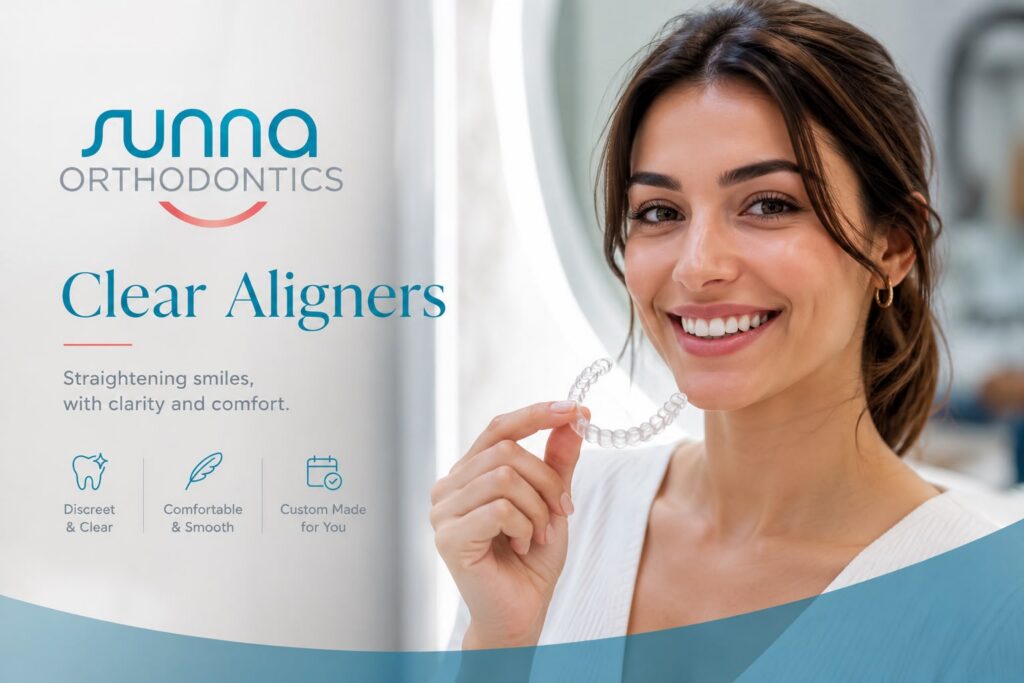
Orthodontic treatment has evolved significantly over the past two decades. While traditional braces remain a highly effective and widely used option, clear aligners have emerged as a clinically proven alternative that offers patients a discreet, comfortable, and flexible path to a straighter smile.
At Sunna Orthodontics, we believe every patient deserves to understand all their options, clearly and honestly. Here is everything you need to know about clear aligners.
How Do Clear Aligners Work?
Clear aligners are a series of custom-fabricated, removable trays made from a smooth, medical-grade thermoplastic material. Each tray is precisely designed using digital imaging and 3D treatment planning software to apply controlled forces to specific teeth at specific stages of treatment.
Patients wear each set of aligners for a designated period, typically one to two weeks, before progressing to the next tray in the series. With each new tray, the teeth are guided incrementally closer to their target positions. The cumulative effect of this sequential movement is a fully corrected bite and alignment.
The total number of trays varies depending on the complexity of the case — simpler cases may require fewer trays, while more complex tooth movements require a longer series.
What Can Clear Aligners Treat?
Modern clear aligner therapy has advanced considerably and can address a wide range of orthodontic conditions, including:
• Crowding — teeth that overlap or are too close together
• Spacing — gaps between teeth
• Overbite — upper front teeth that excessively overlap the lower front teeth
• Underbite — lower teeth that protrude beyond the upper front teeth
• Crossbite — upper and lower teeth that do not meet correctly
• Open bite — a gap between upper and lower teeth when the mouth is closed
It is important to note that not every case is suitable for aligner therapy. Severe skeletal discrepancies or complex bite issues may still require traditional braces or a combination of both approaches. A thorough clinical assessment by your orthodontist is the only way to determine which treatment is right for your specific case.
The Advantages of Clear Aligners
Aesthetics
The most immediately noticeable advantage is appearance. Clear aligners are virtually invisible during wear, making them a popular choice for adults and teenagers who prefer a discreet treatment option.
Comfort
Because the trays are made from smooth plastic with no brackets or wires, there is significantly less risk of soft tissue irritation to the lips and cheeks. Patients transitioning from a previous experience with traditional braces often remark on how comfortable aligners feel in comparison.
Removability
Unlike fixed appliances, clear aligners can be removed for eating, drinking, brushing, and flossing. This means no dietary restrictions and no compromise to oral hygiene during treatment, two of the most significant practical advantages of this system.
Predictability
Digital treatment planning allows both the orthodontist and the patient to visualize the expected outcome before treatment even begins. This level of precision and transparency is one of the defining features of modern aligner therapy.
The Responsibilities of Aligner Treatment
Clear aligners offer significant advantages, but they also require a level of patient compliance that fixed appliances do not.
For treatment to progress as planned, aligners must be worn for a minimum of 21 to 22 hours per day. Removing them too frequently or for extended periods will slow tooth movement and can compromise the final result.
Aligners must be removed before eating or drinking anything other than water. They must be cleaned regularly to maintain hygiene and clarity. And each new tray must be worn on schedule to keep treatment on track.
For patients who may struggle with the discipline of consistent wear, this is an important consideration when choosing between aligners and braces. Your orthodontist will help you make an honest assessment.
Caring for Your Aligners
Maintaining your aligners properly is straightforward but important.
Rinse your aligners with cold water each time you remove them. Clean them gently with a soft toothbrush, avoid toothpaste, which is abrasive and can scratch the surface, making the trays appear cloudy. Store them in their protective case whenever they are not in your mouth, and keep them away from heat, which can warp the plastic and affect their fit.
Always brush and floss your teeth before reinserting your aligners after meals. Trapping food or bacteria beneath the tray creates conditions for decay and is one of the most common mistakes aligner patients make.
Aligners for Teenagers
Clear aligners are not exclusively an adult treatment. Many teenagers are excellent candidates, and aligner systems designed specifically for younger patients include features such as compliance indicators, small dots on the tray that fade with wear, allowing parents and orthodontists to monitor whether the aligners are being worn as directed.
For teenagers who are self-conscious about their appearance during treatment, aligners can make a meaningful difference in confidence and willingness to engage socially throughout the process.
Is Aligner Treatment Right for You?
The only way to know with certainty whether clear aligners are suitable for your case is through a comprehensive orthodontic assessment. Factors including the complexity of tooth movement required, jaw relationship, age, and patient compliance all play a role in determining the most appropriate treatment approach.
At Sunna Orthodontics, we take the time to evaluate each patient individually and present all available options, so that the decision you make is fully informed and right for your specific situation.
The Bottom Line
Clear aligners represent one of the most significant advances in modern orthodontics, offering patients an effective, discreet, and comfortable route to a corrected smile. Like all orthodontic treatment, their success depends on the skill of the clinician, the quality of the treatment plan, and the commitment of the patient.
When all three are in place, the results speak for themselves.